- 22.5 kmLongest natural lake in the Rockies
- 3,268 mMount Unwin, tallest peak behind Spirit Island
- 100–120Estimated grizzly bears in Jasper N.P.
- 1908Mary Schäffer's expedition to the lake
- From $86Cruise starting price
The Animals, the Mountains, the Glaciers — and the Geology Behind the Colour
This guide is about what you'll actually see on the Maligne Lake Cruise — the animals, the mountains, the glaciers, and the geology behind that famous turquoise colour — and how to give yourself the best chance of seeing it. For the full experience overview, start with the complete Maligne Lake Cruise guide; for timing your visit around wildlife and light, see the best time to take the cruise.
And the drive in, along one of Jasper's best wildlife corridors, can serve up bears, moose, and eagles before you ever reach the dock. Here's the counterintuitive part most first-timers miss: the best wildlife viewing usually happens from your car on Maligne Lake Road, not from the boat itself.
The Lake Itself
Maligne Lake is the largest natural lake in the Canadian Rockies — roughly 22.5 km long, up to about 97 metres deep, sitting at around 1,670 m elevation, some 600 m higher than Jasper town. It's fed and drained by the Maligne River and cold year-round, averaging about 4°C, which is why it's a lake to sail on rather than swim in.
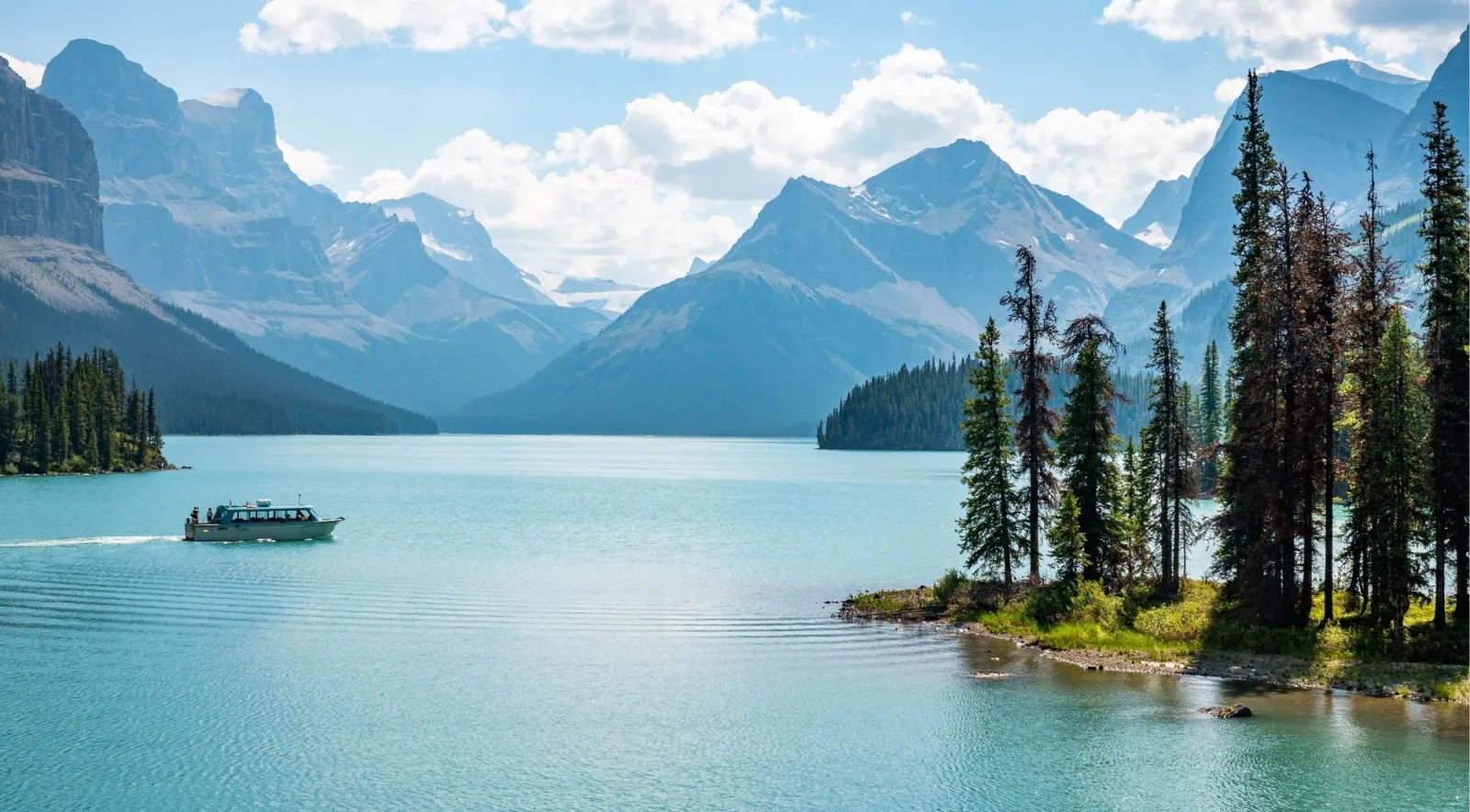
That famous colour comes from glacial rock flour — fine rock particles ground by the glaciers and carried in by meltwater, staying suspended in the water and scattering blue-green light. One thing you'll notice on the cruise: the water shifts from bright turquoise near the north dock to a deeper emerald-jade the farther south you sail, because you're moving closer to the glaciers and higher concentrations of that rock flour.
The lake was known to the Stoney Nakoda as Chaba Imne ("Beaver Lake"). It was mapped for the explorer Mary Schäffer by Samson Beaver, and Schäffer reached it in 1908, returning to survey it in 1911 and naming many of the peaks you'll see. Group of Seven painter Lawren Harris later immortalised the lake on canvas in the 1920s.
Other Jasper Wildlife & Scenery Experiences
If the standalone Spirit Island cruise has you wanting more wildlife time, a dedicated Maligne Valley wildlife drive, an evening wildlife search, the Jasper SkyTram, and the Columbia Icefield on the Icefields Parkway all pair well on a longer Jasper itinerary.
The Mountains and the Hall of the Gods
The peaks ringing the lake belong to the Front Ranges of the Rockies — the Queen Elizabeth Ranges and the Maligne Range. As you sail south, your guide will point out the named summits.
Mount Unwin & Mount Charlton
Mount Unwin (3,268 m) and Mount Charlton (3,217 m) rise together on the west side, forming the dramatic backdrop directly behind Spirit Island. Near Samson Narrows, their cliffs and glaciers tower more than 1,500 m above the shoreline.
Samson Peak & Leah Peak
Samson Peak (3,081 m) and Leah Peak (2,801 m) stand on the eastern shore, named for Samson Beaver and his wife Leah, who helped guide Mary Schäffer's 1908 expedition to the lake.
Monkhead & Mount Brazeau
Monkhead, a massive summit near the south end, screens the view of Mount Brazeau (about 3,470 m) — the highest peak in the area, largely hidden from the Classic Cruise and only revealed from the far south of the lake.
The amphitheatre of peaks gathered behind Spirit Island is often called the Hall of the Gods — and it's the reason the view is so photogenic, the small cluster of trees framed by water and encircled by mountains.
The Glaciers
Three hanging glaciers are classically named as visible from the lake — the Charlton, Unwin, and Maligne glaciers — clinging to the high peaks along the western shore. These are the source of the meltwater and rock flour that colour the water.
An honest note on what you'll see: on the standard Classic Cruise to Spirit Island (about 14 km down the lake), your guide will point out these hanging glaciers on the peaks as the boat motors south, and the water visibly deepens in colour. But the biggest, closest glacier views — the Coronet Glacier and the full Brazeau massif — sit at the very head of the lake, roughly 7 km beyond Spirit Island, reachable only by canoe or kayak to the backcountry. So the cruise shows you glaciers draped high on the mountains, not the up-close valley glacier of the far south end. It's worth knowing that going in, so the scenery meets your expectations.
The Wildlife
Here's the key thing most first-timers get wrong: the best wildlife viewing usually happens from your car on Maligne Lake Road, not from the boat. The road is widely regarded as the finest wildlife corridor in Jasper, winding through wetlands, forest, and meadow.
On Maligne Lake Road
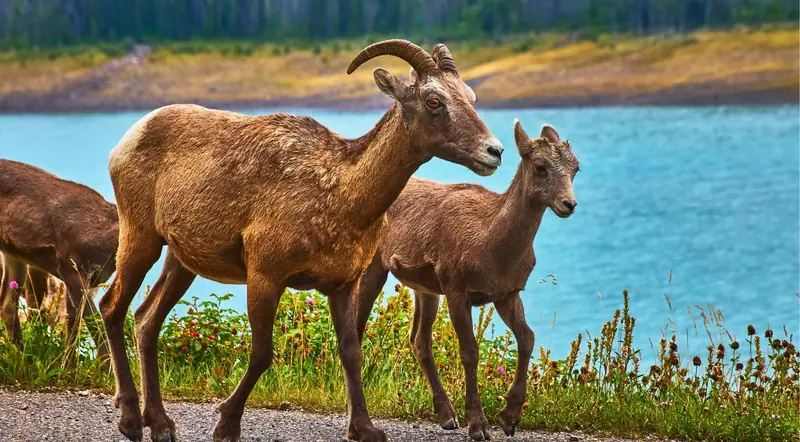
Black bears are the most commonly spotted, often roadside in forest and berry patches. Grizzly bears are less common (the park supports an estimated 100–120) but regularly seen along the road, especially in spring. Moose are genuinely special, as the park holds only around 150; the upper road between Medicine Lake and Maligne Lake is one of the most reliable spots. Elk are common roadside — be especially wary of aggressive bulls during the September–October rut. Mule and white-tailed deer are frequent roadside sightings, and bighorn sheep and mountain goats are present but less reliably seen here than elsewhere in the park. A wolf is a rare, lucky sighting; coyotes are more common.
On the water and in the air
Moose are sometimes seen at the lakeshore or even from the boat, feeding in the shallows. Maligne Lake is a noted spot for common loons and harlequin ducks, and bald eagles and ospreys are often seen fishing or perched. Cruise passengers regularly report eagles and loons on the water.
A note on caribou
Woodland caribou once roamed the Maligne Valley, but the Maligne herd is now considered extirpated — it dwindled over years and the last animals were gone by around 2018. So despite what some older guides suggest, you should not expect to see caribou here. Parks Canada is running a long-term conservation breeding program that may, over the coming decades, return caribou to these ranges, but that's a future hope, not a current sighting.
Best times for wildlife
Early morning and evening — the "golden hours" — are far and away the best for spotting animals, and spring is an especially active season. Drive Maligne Lake Road slowly in the first couple of hours after sunrise or the last before sunset, use pullouts rather than stopping in the lane, and keep your distance. More on seasonal timing is in the best time to take the cruise.
What the Narration Covers
From the moment the boat leaves Home Bay, a guide narrates the sail. Expect to hear about the ancient rockslides scarring the valley walls, the geology and fault lines of the peaks, the glaciers as you motor south, how sediment has pinched the lake at Samson Narrows, the local wildlife, Mary Schäffer's 1908 expedition, and the Stoney Nakoda history and meaning of Spirit Island. As the boat nears the island, the captain typically cuts the motor so passengers can step onto the rear deck for the full panorama.
Spirit Island and Its Meaning
Spirit Island is a tiny, tree-topped islet — really a peninsula joined to the shore by a low, rocky spit for most of the year, becoming a true island only briefly at high water. Its worldwide fame took off after a photograph of it was displayed by Kodak in New York's Grand Central Terminal in 1960, and it endures as one of the most photographed scenes in Canada.
It's also deeply sacred to the Stoney Nakoda First Nation, who regard the encircling mountains as representations of their ancestors — and Spirit Island is exceptional because it's nearly surrounded on three sides by the same range. When Jasper National Park was established, the Stoney Nakoda were displaced from these lands; in recent years members have been able to return for ceremonial purposes. Out of respect, and to protect the islet's fragile vegetation, visitors don't set foot on the island itself — you view and photograph it from a short trail to a wooden platform nearby.
The Drive In: Medicine Lake and the Disappearing Water
On the drive up Maligne Lake Road you'll pass Medicine Lake — the "disappearing lake," which has no consistent surface outlet and drains through sinkholes into one of the world's largest underground cave systems. In summer, glacial meltwater fills it faster than it can drain, creating a long lake; by late fall the inflow drops and the basin empties to mudflats and a braided river. The water resurfaces roughly 16 km downstream. It's a genuinely strange and memorable stop, and a reliable wildlife spot too. Full turn-by-turn directions and parking details are in our guide to getting to Maligne Lake from Jasper.
Seasonal Scenery
Spring (late May–June)
Ice-off (often not until late May), high meltwater, a roaring Maligne River, and the best wildlife activity — though the lake may still be partly frozen early.
Summer (July–August)
Peak turquoise colour, wildflowers in the alpine meadows, warmest sailings, and the busiest boats.
Fall (September–early October)
Golden aspen in the valleys and fresh "termination dust" snow on the peaks. One thing to know: the alpine larches that turn Banff and Lake Louise gold don't grow in the Jasper area, so Maligne's autumn colour comes from aspen and poplar rather than larch.
Winter
The lake freezes and cruises stop for the season.
Conservation and Respect
Don't stop in the traffic lane for "animal jams" — pull fully off the road, and keep well back from wildlife (Parks Canada advises 30 m from large animals and 100 m from bears). Never approach or feed animals. Seasonal backcountry closures protect critical caribou winter habitat, including areas along the west side of the lake. And only non-motorized craft (plus the licensed cruise boats) are allowed on the water, which helps keep the lake pristine.
The 2024 Wildfire, Seen from the Road in 2026
The 2024 Jasper wildfire — the largest in the park in over a century — burned south from the town end and through parts of the lower Maligne Valley. On the drive to the lake you'll pass through visibly burned forest in places: blackened and fallen lodgepole pine with new green growth pushing up between them. In some spots the fallen trees have actually opened up views and can make roadside wildlife easier to spot.
Closed for the 2026 season
- Maligne Canyon remains closed for the entire 2026 season for wildfire-recovery and slope-stability work, so you can't pair the cruise with a canyon walk this year.
Open and unaffected
- The Maligne Lake and Spirit Island area was spared. The boathouse and lake structures survived, and Spirit Island itself is unchanged. You can still stop at Medicine Lake and the Maligne Lookout on the way in.
How to See the Most
Drive early and slowly
Treat the road in as a wildlife safari, using pullouts and scanning the meadows between Medicine Lake and Maligne Lake.
Book the first sailing — or the Premium
The first sailing gives the calmest water and sharpest reflections of Charlton and Unwin. Or book the Premium Cruise for late-afternoon "spotlight" light on Spirit Island and more time ashore.
Head for the open rear deck
Especially as the boat pulls away from the island and the water-level view of the Hall of the Gods opens up.
Dress in layers with a windproof shell
The wind picks up past Samson Narrows and the deck gets cold fast. See the full packing checklist.
Dedicated Wildlife Tours to Add to Your Trip
If the standalone Spirit Island cruise leaves you wanting more time watching for animals, these two options add a dedicated wildlife focus to your Jasper trip.
 Cruise + wildlife drive
Maligne Valley Wildlife & Spirit Island Cruise
Adds a wildlife-watching drive up the Maligne Valley to the Spirit Island cruise — the full valley experience in one guided package, particularly worthwhile in spring or early autumn when wildlife is most active roadside.
Maligne Valley Wildlife & Spirit Island Cruise · ★ 4.6 (249 reviews) · From $141 Check availability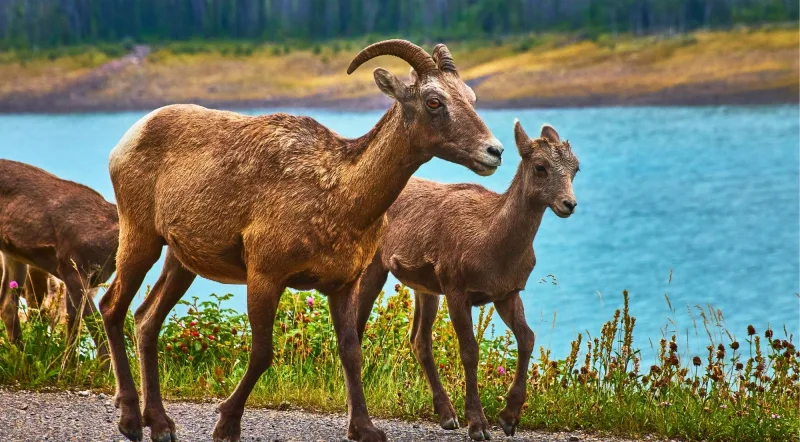 Dedicated wildlife search
Evening or Morning Wildlife Watch Tour
A small-group search focused entirely on wildlife, timed to the golden-hour windows when animals are most active — no cruise included, just dedicated time in the vehicle with a spotting guide.
Evening or Morning Wildlife Watch Tour · ★ 4.6 (1,076 reviews) · From $69 Check availabilityBook the Maligne Lake Cruise to Spirit Island
Morning sailings (best for wildlife and reflections) and the evening Premium sell out first.
Jasper National Park: Maligne Lake Cruise With Guide
Booking tip: the availability widget above shows live dates — if you see your preferred date available, book it immediately. Morning sailings are consistently the first to fill. No cell service at the lake — download your voucher before you leave Jasper town.
The narrated 14 km round-trip cruise from Home Bay to Spirit Island and back — through Samson Narrows, into the steep-walled "Hall of Gods" — with an onboard guide covering the geology, wildlife, and Indigenous history of the Maligne Valley.
- Narrated round-trip cruise to Spirit Island
- Onboard interpretive guide
- Time at the Spirit Island viewpoint trail
- Glass-enclosed, heated boat — runs in rain
- Mobile voucher accepted
Full step-by-step booking details, sold-out-date tips, and the refund policy are in our how-to-book guide.
Check availability & pricesWildlife & Scenery: Frequently Asked Questions
The questions visitors most often ask about what they'll actually see.
What wildlife will I see on the Maligne Lake Cruise?
Sightings aren't guaranteed, but you might see black or grizzly bears, moose, elk, deer, bald eagles, ospreys, and loons — most often from the car on Maligne Lake Road rather than from the boat. Early morning and evening give the best chances.
Can you see glaciers from the cruise?
Yes — hanging glaciers (the Charlton, Unwin, and Maligne glaciers) cling to the peaks along the lake and are pointed out as you sail south. The largest glaciers at the head of the lake, beyond Spirit Island, are only reachable by paddling.
What mountains can you see from Spirit Island?
The amphitheatre behind Spirit Island — the Hall of the Gods — is anchored by Mount Unwin (3,268 m) and Mount Charlton (3,217 m), with Samson Peak and Leah Peak on the eastern shore and Monkhead and Mount Brazeau to the south.
Are there caribou at Maligne Lake?
No longer. The Maligne caribou herd is considered extirpated, with the last animals gone by around 2018. A long-term conservation program may eventually return caribou to the area, but you should not expect to see them now.
Why is the water so blue?
The turquoise comes from glacial rock flour — fine sediment ground by the glaciers and suspended in the meltwater, which scatters blue-green light. The colour deepens toward emerald as you sail south, closer to the glaciers.
Can I walk on Spirit Island?
No — the island is off-limits out of respect for its significance to the Stoney Nakoda First Nation and to protect its fragile vegetation. You view and photograph it from a short trail to a viewing platform nearby.
More Maligne Lake Cruise Guides
Pick your window and plan the drive — the two guides that pair naturally with this one.
 When to go
Best Time to Take the Maligne Lake Cruise
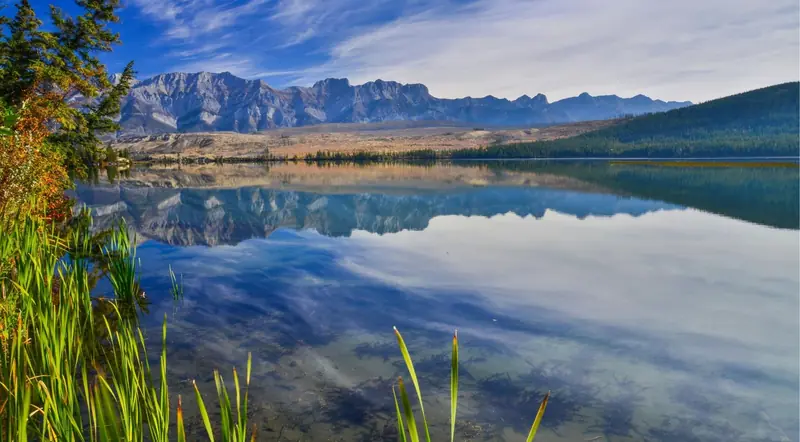
Month-by-month water colour, crowds, and light — plus the best time of day for wildlife and reflections.
See the timing guide →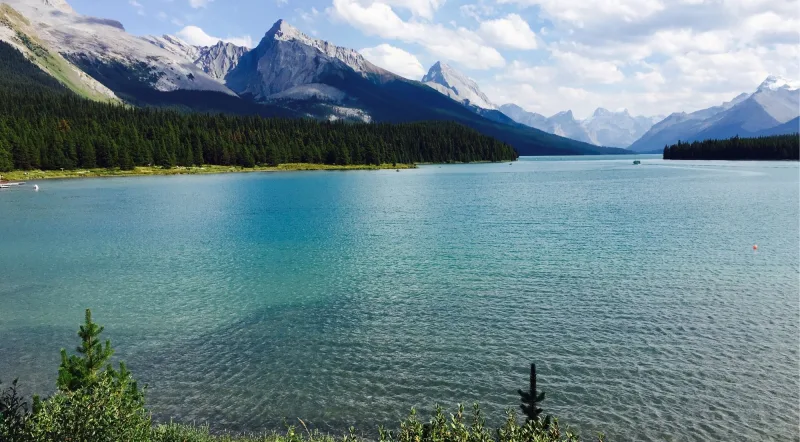 Getting there
Getting to Maligne Lake from Jasper
Turn-by-turn directions, the 48 km drive, free parking, and shuttle options if you don't have a car.
See the directions →